


The natural world according to the tourist industry is an object to be used for our own consumption. Nature is what tourism constructs: the being of the natural world is what it is like for beings like us. Tourism places nature in a picture frame as natural beauty to be gazed at by us. This enframing transforms the natural world into a reservoir of resources, ready and awaiting our usage. We don’t see ourselves as participants within a dynamic, wild world with its own life.

Yet this patch of nature has its own life and dynamism which is ignored. We don’t see nature in itself as teeming with life and productivity; having an inner dynamics; or being in various states of becoming and in constant flux and metamorphosis; or having its own history that extends deep into the past.
This Naturphilosophie — a philosophy of nature — has been pushed way back into our cultural background. Even though it could help us to reconfigure our relationship to nature by displacing our anthropocentric view of nature, the philosophy of nature (eg., that of a Friedrich Schelling or Hegel) has been relegated to our museum of historical misguided proto-scientific philosophies by a natural scientific physicalism. We are left with traces of a dynamic, historical nature that remains invisible, shrouded in darkness in a world framed by the bright lights of tourists seeking grand vistas and sandy beaches. Hence that barely noticed background to our individual agency of a degraded strand of straggly melaleucas.
The historical development of large format landscape photography in Australia has been primarily concerned with the conservation of patches of a mostly wild nature. It usually focuses on the being of a particular object in the natural world — this tree or rock formation — to help remind us of what nature is and what once was. Though it often embodies memory and place, it is generally seen as either culturally conservative (gum tree art), or as green politics by the modernist art world, and so excluded from being in the art world as an autonomous art work. This gatekeeping is reinforced by this approach to photography usually placing an emphasis on beauty and avoiding or eliminating the site/nonsite dimension with its critical contemporary conceptualization.
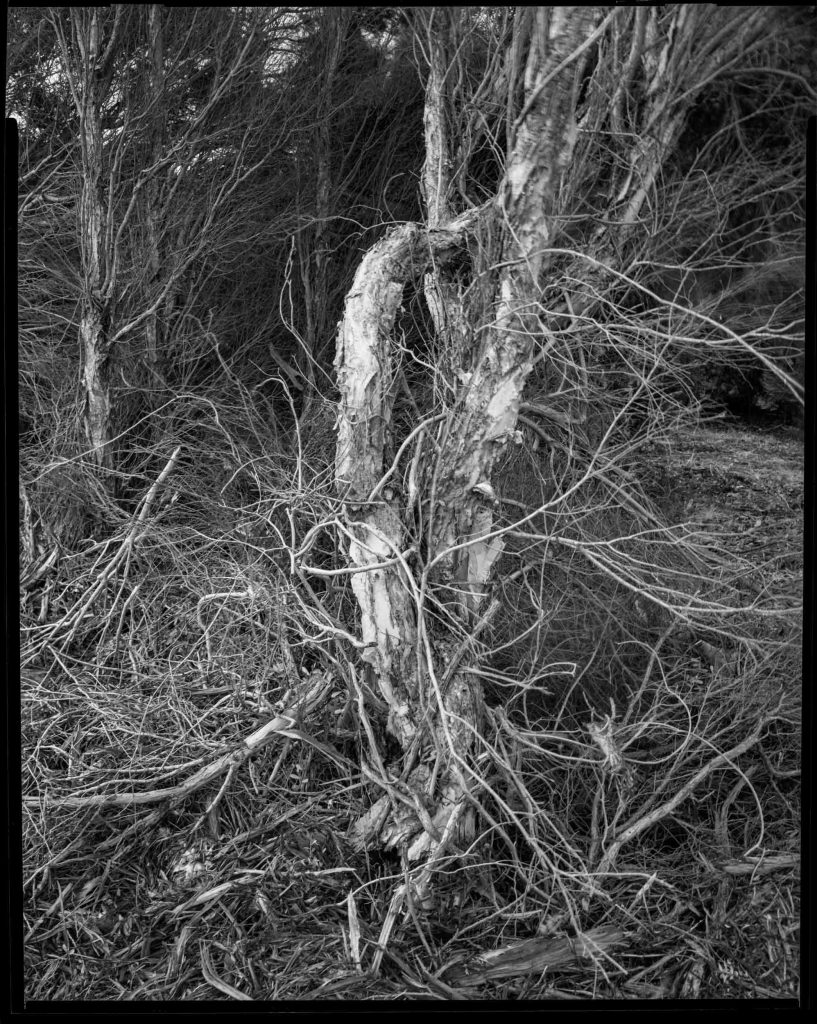
The modernist artworld’s rejection of large format photography of nature is akin to the rejection of the philosophy of nature. Rejection is a strange way to understand this approach to landscape photography, given the increasing intensity of the droughts and floods due to the current climate heating resulting from the way we have treated nature through the extensive use of fossil fuels in industrial capitalism.
This traditional response by the art world is unconvincing, given that, in the contemporary post historic era, everything can be art. The inflexiblity of the artworld response is questionable when large format landscape photographers and philosophers represent and think about the fundamental features of the natural world — ie., those features that make the natural being what it is. In doing so they explore what those features are, how those features are or aren’t related to one another, and how those features (and their relationships) are accessed.
Even though an autonomous art no longer serves as our primary way of reflecting on ourselves and our form of life, it still as a reflexive practice gives us perspectives on our knowledge and practices that enables us to reflect on how we view nature in our form of life. We do need to start thinking about nature differently to the entrenched approach of nature as a resource that is used and abused by us. We also need to consider the ways in which artworks and practices register and take up social reality within their own self-limiting historical unfolding.