


In relation to capitalist post-modernity in Australia mono no aware as an aesthetic category would refer more to the flux of nature than to the flux of society. The branch of a eucalyptus tree (Eucalyptus fasciculosa) in the bushland cracks from the strong, invisible wind and the summer heat, crashes to the earth, and over time its leaves slowly dry out, decay, crumble, and fall to the ground. The surface of the earth in the local bushland is carpeted with leaves in various states of decay.
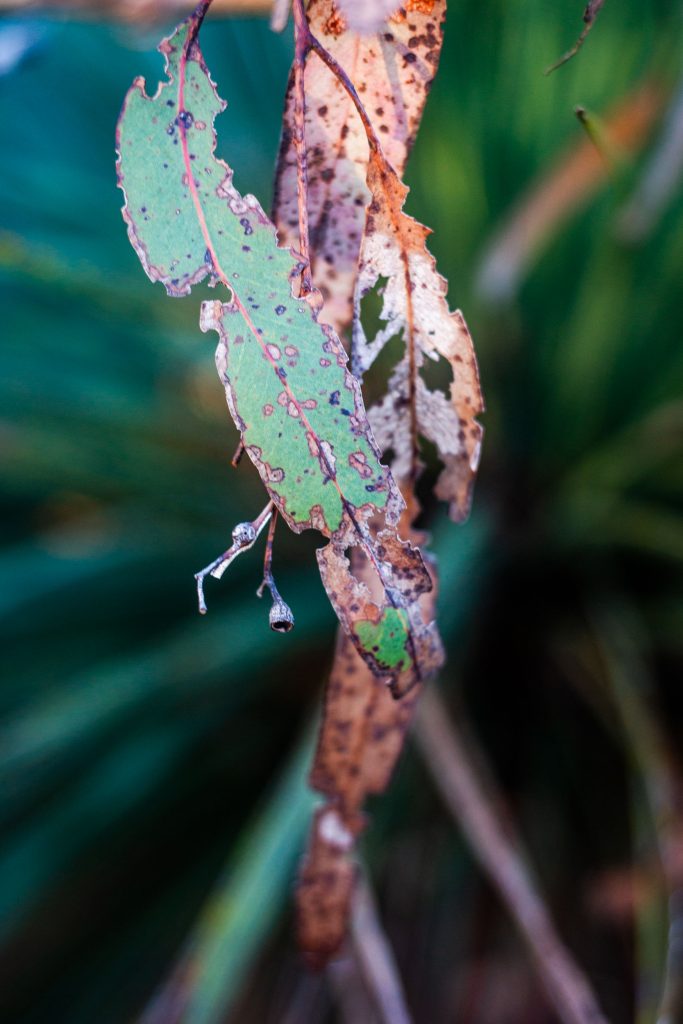
So why the turn to the classical Japanese aesthetic category of mono no aware that is premised on the flux in the natural world?
Firstly, it opens up a space to move away from the dominant currents in our culture in modernity: namely the physicalism and scientific reductionism of mainstream Anglo-American analytic philosophy‘s interpretation of the natural sciences (ie., all sciences should reduce to physics); and secondly its opposition in the form of an emphasis on subjectivity (personal expression) in western aesthetics in modernity.
Secondly, turning to Japanese aesthetics also enables us to move beyond an analytic aesthetics, which as until very recently, spent much of its time narrowly obsessed with things like the ontological status of ‘the work of art’. Turning to Japanese aesthetics also allows us to move beyond a postmodernism informed by a form of French post-structuralism that reduces the world of nature to as a social construct in the form of text–ie., textuality.
This moving away from the philosophical and artistic prejudices of the present towards mono no aware takes us to the threshold of seeing the local Waitpinga bushland as a dynamized nature in a world of flux. This enables us to move towards a photography informed by a philosophy of nature; one that has non-anthropocentric conception of nature; and one that points towards an understanding of nature through the forces that constitute it.

What emerges from turning to pre-modern Japanese aesthetics to understand the nature of the Waitpinga bushland is an anti-anthropocentric realism that affirms a dynamic nature’s full independence of any cognitive relation to it. This, in turn, informs a photography of nature that is able to be different to the traditional landscape photography.

This alliance of nature photography and nature philosophy opens up a space for an independent landscape photography that exists on the margins of the art world to explore the idea of an enduring or historical present. The beingness of the leaves in the present is shaped by what they have been and what they will become. This awareness of the history of nature opens up a world for a contemporary photography.